

.svg)
The Rise of AVoIP: Building Scalable, Future-Ready Media Infrastructures
December 19, 2025

Media workflows in Singapore are becoming more demanding, with teams managing higher volumes of content, wider coverage areas and increasingly complex production setups. Traditional point-to-point cabling often struggles to keep up, especially when organisations need to expand quickly or support multiple rooms, hybrid events or distributed operations. As spaces become more connected, there is a growing need for AV systems that are easier to scale, simpler to manage and better aligned with modern IT environments.
This is where AV-over-IP (AVoIP) comes in. At its core, it is the process of sending audio and video signals through standard IP networks rather than relying on traditional point-to-point cabling. By using the same infrastructure that already carries everyday data and communication, it removes many of the physical limitations that previously restricted system design and makes routing far more flexible.
The approach also simplifies expansion. New rooms, displays or sources can be added to the network with minimal disruption, which is especially helpful in environments that manage dynamic events, hybrid formats or multi-space setups. Combined with support for network-based media distribution, digital AV integration and scalable media systems, AVoIP offers an adaptable, future-ready way to meet growing operational demands across connected facilities.
One of the strongest advantages of this approach is the ease of expansion. New displays, sources, or rooms can be added through the same network without extensive cabling, keeping growth simple and far less disruptive in large facilities.
Flexibility also improves. Signal paths can be adjusted via software rather than physical rewiring, allowing quick changes during events, lessons, recordings, or worship services. This gives teams the freedom to reconfigure spaces as needs evolve, supporting dynamic environments with much less effort.
Cost management is another area where this method stands out. By relying on standard Ethernet cables and switches, organisations avoid the high expense of proprietary AV cabling. Upgrades and replacements also become simpler because the components are widely available.
Centralised management adds further value. Platforms such as Q-SYS give administrators a single interface to monitor signal flow, check device status and troubleshoot issues. This reduces downtime and supports smoother day-to-day operations. With fewer specialised parts and less hardware waste, the overall approach also encourages more environmentally mindful planning over time.
Consistent audio and video quality depends heavily on the strength of the underlying AV network, especially when signals need to travel across large facilities or multiple buildings. Modern codecs help preserve clarity, but reliable performance ultimately comes from networks designed to handle real-time media traffic without congestion or unpredictable latency.
Dedicated AV networking technologies, such as the Netgear AV Line switches, are built to prioritise media streams, manage bandwidth efficiently and maintain stable signal delivery. This network-first approach makes it easier to integrate with broader audiovisual solutions, digital signage, control platforms and conferencing tools. As a result, enterprise AV infrastructure becomes more cohesive, allowing content, control and communication systems to operate smoothly across the entire environment.
Future-readiness is built into the design. Systems can evolve through software updates and modular hardware rather than complete infrastructure overhauls, making it easier to adapt to new formats or standards when they emerge.
Long-distance distribution adds further flexibility. Since content travels over an IP network, signals can move between buildings or across campuses with minimal effort. This positions the technology as a strong foundation for organisations building media ecosystems that remain scalable and relevant over time.
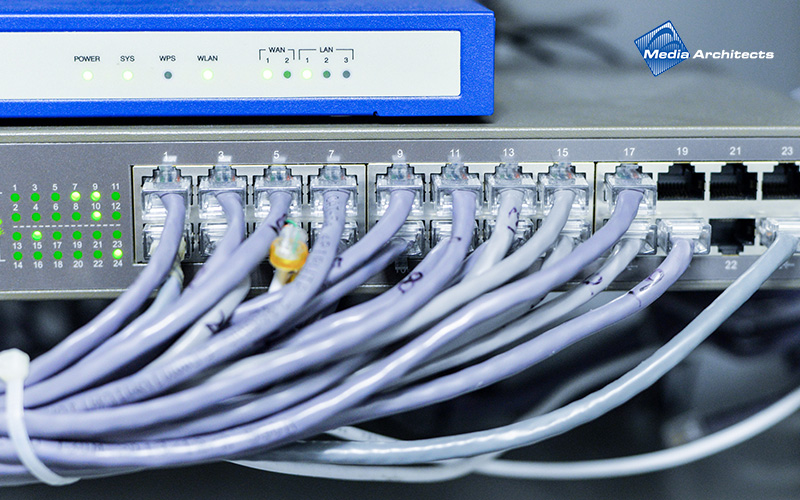
Greater scalability, reduced infrastructure costs, seamless IT integration and consistent media quality have made AVoIP a practical option for organisations upgrading their systems. It supports smarter planning, adaptable workflows and long-term sustainability, creating connected environments that handle changing operational needs with ease. For teams looking to modernise their professional audiovisual setup, it offers a reliable and forward-looking direction.
Ready to build a more scalable and future-ready AV network? Contact Media Architects to explore solutions that fit your organisation’s needs.
Related Pages
Other articles

January 7, 2026
Key Takeaways: Centralised control allows production teams to manage multi-location events more smoothly, offering greater consistency and operational clarity. Remote setups help organisations reduce on-site manpower and logistics costs, creating...

Key Takeaways: Enterprise training is moving beyond one-off workshops towards continuous learning systems that support long-term skill development and workforce adaptability. Digital platforms powered by modern educational technologies create scalable...

.svg)