

.svg)
Digital Education: How the New AI Feature Benefits Educators
June 19, 2025

The educational sector is experiencing a revolutionary shift, driven by the integration of artificial intelligence (AI) tools. These innovations are transforming traditional teaching methods, making education more accessible and efficient. Among the key players in this transformation is Panopto, whose recent launch of advanced AI features exemplifies the potential of cutting-edge education technology solutions.
Panopto’s AI-driven tools are designed to enhance both teaching and learning experiences. For educators, these features provide opportunities to deliver more engaging and impactful lessons. For students, they offer intuitive ways to access, navigate, and understand educational content. Whether through AI-generated summaries, multilingual captions, or intelligent content organisation, these tools empower users to achieve better outcomes in a digital or blended learning environment.
By addressing challenges like language barriers, resource limitations, and the need for personalised learning, AI is redefining how education is approached. As institutions increasingly adopt online learning tools and virtual learning environments, the role of adaptive learning technology becomes indispensable. This article explores Panopto’s AI features in detail, highlighting their benefits for educators and students and their implications for the future of education and education technology solutions.
One of the most innovative features of Panopto’s AI capabilities is the ability to generate concise summaries of lecture recordings. These AI-generated synopses encapsulate the three main points discussed in a session, offering numerous benefits to students and educators alike.
For students, these summaries provide a quick and efficient way to understand the core content of a lecture without needing to view the entire recording. This not only saves time but also helps in retaining critical information, particularly in complex or detailed subjects. By focusing on the essential takeaways, students can streamline their study process and reinforce their understanding of key concepts.
For educators, these synopses act as a reflective tool to evaluate whether their lectures effectively communicate the intended messages. They can use the insights provided to adjust their teaching strategies, ensuring that their content aligns with learning objectives. Additionally, AI-generated summaries support educators in preparing supplemental materials or follow-up discussions that address gaps or emphasise critical areas.
This AI feature exemplifies how this technology can enhance the overall learning experience by improving accessibility and supporting both active and self-directed learning. By transforming how content is consumed and evaluated, AI-generated synopses are a step forward in modernising education technology solutions.
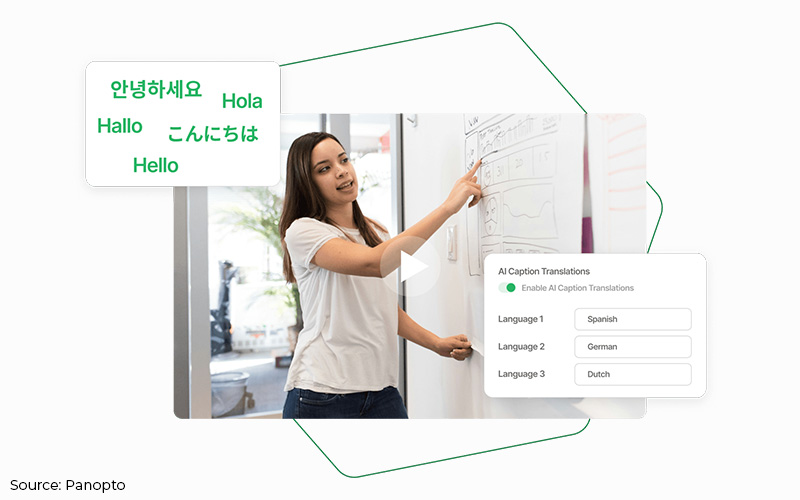
Panopto’s AI-powered language support feature provides automatic captioning in 18 different languages, significantly improving accessibility for diverse student populations. This AI feature is a game-changer for international students and non-native speakers, as it bridges linguistic gaps and ensures that everyone can engage with educational content effectively.
By automating captioning, Panopto’s AI feature eliminates the need for manual transcription and translation services, resulting in significant cost savings for educational institutions. These resources can then be redirected to other critical areas, such as curriculum development or faculty training.
Inclusivity is another hallmark of this AI feature. By catering to a wide array of linguistic backgrounds, Panopto helps create an equitable learning environment where all students, regardless of language proficiency, can thrive. For students who struggle with lectures in a non-native language, captions provide an invaluable tool for comprehension and review.
This advanced language support feature also benefits educators by allowing them to reach broader audiences without additional effort. Whether in a blended learning setup or a fully virtual learning environment, the ability to deliver content in multiple languages enhances both reach and impact. Panopto’s language support is a testament to how EdTech solutions can promote inclusivity and efficiency in education.
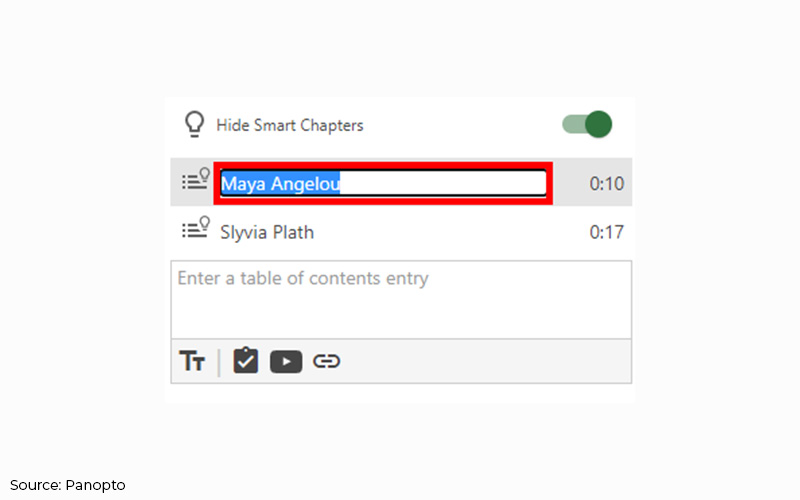
Navigating long lecture recordings can often be overwhelming for students. Panopto’s smart chapters feature addresses this challenge by automatically creating chapter markers based on audio content. These markers provide a clear and accurate breakdown of lecture topics, making it easier for students to engage with the material.
Using advanced AI algorithms, smart chapters analyse the dialogue and context of each lecture to generate meaningful headings. This contextual understanding ensures that the chapter titles align closely with the subject matter, improving the navigation experience for students. By offering a logical structure, this AI feature enables learners to locate specific topics or revisit challenging sections without spending excessive time searching through entire videos.
For educators, smart chapters provide an efficient way to organise content. They can easily review the chapter markers to ensure alignment with their lesson plans or use them to guide post-lecture discussions. Additionally, this AI feature supports a more interactive learning environment, as students can actively reference specific chapters during collaborative activities or study groups.
Overall, smart chapters enhance the usability of online learning management systems by simplifying access to critical information. This functionality exemplifies how adaptive learning technology can streamline educational workflows and improve the virtual learning environment for both students and teachers.
Panopto’s AI features also build interactive learning by enabling more dynamic engagement with educational content. The integration of smart chapters and AI-generated summaries allows students to access specific segments of lecture videos easily, encouraging active participation in their learning process.
With quick access to targeted content, students can engage in meaningful discussions, whether in the classroom or during collaborative online sessions. This accessibility promotes a more interactive learning experience, as students can ask informed questions, clarify concepts, and contribute insights based on precise lecture segments. Additionally, these tools support self-directed learning, empowering students to tailor their study sessions to focus on areas where they need the most improvement.
Educators benefit as well by using these features to create interactive assignments or discussion prompts based on specific chapters or summaries. This helps bridge gaps between live teaching sessions and recorded materials, ensuring continuity in the learning process. Furthermore, the ability to highlight key segments enables educators to reinforce important concepts and provide targeted feedback.
By combining accessibility with interactivity, Panopto’s features exemplify how digital learning platforms can transform the education landscape. These tools are designed to meet modern educational demands by fostering collaboration, personalisation, and engagement in a virtual learning environment.

As educational institutions embrace digital transformation, the scalability of AI features like those offered by Panopto becomes critical to meeting the evolving demands of modern learning environments. One significant advantage of AI is its ability to adapt to the diverse needs of educational institutions, whether serving small schools or large universities.
AI tools can support scalable learning environments by creating personalised learning paths tailored to individual student needs. For instance, AI algorithms can analyse student performance and provide customised recommendations, enabling a more adaptive and effective learning experience. This level of personalisation is especially beneficial in blended learning setups, where students require seamless transitions between virtual and in-person learning.
Moreover, AI-driven automation in areas such as content generation, language support, and data analysis allows institutions to optimise their resources. By streamlining these processes, educators can dedicate more time to teaching and curriculum development while administrative tasks are handled efficiently. This ensures a higher quality of education delivery without overburdening faculty or support staff.
The scalability of AI features also opens doors for institutions to expand their offerings, such as live event video streaming services or online certification programs. As education technology solutions continue to evolve, scalability will remain highly sought after for institutions aiming to deliver impactful, accessible, and efficient learning experiences.
The rise of artificial intelligence in education brings with it important ethical considerations that institutions must address to ensure equitable and responsible use of technology. Data privacy is a paramount concern, as AI features and tools often require access to sensitive student information. Educational institutions must implement robust data protection measures and adhere to regulations such as GDPR to safeguard privacy.
Bias mitigation is another critical aspect. AI algorithms, if not carefully designed and monitored, can perpetuate biases in content recommendations or language processing. Institutions need to continuously evaluate and refine these systems to promote fairness and inclusivity. This involves using diverse training datasets and conducting regular audits to identify and address potential disparities.
Transparency in AI operations is equally important. Educators and students should understand how AI tools function and how decisions, such as content recommendations or performance analyses, are made. Clear communication about the role of AI builds trust and empowers users to engage with the technology confidently.
By prioritising ethical considerations, institutions can harness the full potential of AI while ensuring it serves as a tool for equity and positive change. Responsible implementation of AI not only enhances learning outcomes but also upholds the values of fairness and inclusivity in education technology solutions.
AI-generated synopses offer significant benefits in education by streamlining learning and enhancing accessibility. They provide concise, accurate summaries of complex topics, saving students and educators valuable time. This AI feature can adapt to individual learning needs, highlighting key points for better comprehension and retention. AI-generated synopses also promote inclusivity, catering to diverse learning styles and language proficiencies. Additionally, they support efficient curriculum design by distilling vast content into manageable formats. With their ability to process large volumes of information quickly and accurately, AI-generated synopses empower learners to focus on critical concepts and gain a deeper understanding of educational material.
Panopto’s language support feature enhances inclusivity by offering multilingual captioning and transcription options, making educational content more accessible to diverse audiences. It allows users to generate captions in multiple languages, helping non-native speakers and individuals with hearing impairments understand the material more easily. This AI feature promotes a more inclusive learning environment by breaking down language barriers and ensuring that all students can engage with the content effectively. By providing customizable language options, Panopto helps educators reach a broader audience, fostering equality in education and ensuring that every learner has an opportunity to succeed.
Ethical concerns with AI in education include data privacy, algorithmic bias, and the potential for unequal access. AI systems often rely on personal data, raising concerns about student privacy and the security of sensitive information. Bias in AI algorithms could lead to unfair treatment or reinforce existing inequalities in education. Additionally, unequal access to AI-powered tools could widen the digital divide, leaving disadvantaged students at a disadvantage. It’s essential to ensure transparency, fairness, and inclusivity in AI systems while prioritising the protection of student data and promoting equal opportunities for all learners.
The integration of artificial intelligence in education is redefining how educators teach and students learn, whether through a blended setting using an interactive whiteboard for classrooms, or virtually using online platforms. Panopto’s advanced AI features, such as AI-generated synopses, enhanced language support, and smart chapters, exemplify the transformative potential of education technology solutions. These tools empower educators to deliver more engaging lessons while providing students with intuitive ways to navigate and understand complex content.
As institutions increasingly adopt digital learning platforms, the role of AI in fostering accessibility, efficiency, and inclusivity cannot be overstated. Features like multilingual captions and interactive learning opportunities demonstrate how AI can create a virtual learning environment that caters to diverse needs, making education more equitable and effective.
Looking ahead, the scalability of AI and its potential for personalised learning pathways will further revolutionise the educational landscape. However, this progress must be accompanied by ethical considerations, including data privacy and bias mitigation, to ensure responsible and equitable use of these tools.
Panopto’s AI innovations are a testament to how adaptive learning technology can bridge gaps in traditional education, paving the way for a future where learning is dynamic, inclusive, and impactful.
To learn more about how these EdTech solutions can benefit your institution, or to inquire about how much Panopto costs—we are the sole official distributor of Panopto products in Singapore—if you wish to set it up, please contact us today.
Related Pages
Other articles

January 27, 2026
Key Takeaways: Effective learning spaces are designed around how people see, hear, and interact, not around individual pieces of equipment added later. Audiovisual systems work best when they are planned...

January 15, 2026
Source: LiveU Key Takeaways: The LiveU LU900Q offers a portable yet robust solution for crews that need reliable multi-camera coverage while working across varied locations and event types. Its bonded...

June 20, 2025
Key Takeaways: Live sports production is evolving beyond traditional outside broadcast models, with mobile and remote production technologies enabling more flexible event coverage. Portable transmission systems and bonded cellular connectivity...

.svg)