

.svg)
The New Era of Remote Production (REMI): Centralised Control for Decentralised Teams
January 7, 2026

The rise of distributed production architecture broadcast has changed how organisations in Singapore capture, manage and distribute live content. Broadcasters, universities, churches, production studios, corporations and government agencies are increasingly adopting decentralised setups supported by centralised control rooms. This approach, known as REMI production, enables teams to manage multi-site events with fewer on-site personnel while maintaining broadcast-grade consistency.
With adaptable workflows, dependable IP broadcast systems, and strong IP connectivity, teams are better equipped to react to complex event demands and evolving audience expectations. As operations extend across campuses, countries and hybrid environments, the importance of a well-organised remote integration workflow continues to strengthen.
Many teams today operate across campuses, satellite venues, partner studios or multiple breakout rooms. A remote integration workflow broadcast setup enables producers to manage camera feeds, switching, monitoring, and graphics from a central coordinated control hub. This proves especially useful for institutions of higher learning and faith-based organisations that often run simultaneous sessions across several spaces.
A centralised command centre also reduces friction in live event coordination, eliminates the need to replicate technical setups and gives decentralised teams a clear operational anchor. As more organisations adopt decentralised media operations, unified oversight becomes increasingly essential for maintaining consistent quality and timely decision-making.
Many teams still depend on a strong physical presence at event locations, though this becomes challenging when activities scale or run concurrently. A remote broadcast model allows crews to send only essential camera operators on-site while shifting directing, shading, audio mixing, and graphics control to a central facility. This reduces travel demands, manpower load and the amount of equipment that needs to be transported.
The approach also supports leaner planning cycles and more predictable logistics. With reliable live streaming production hardware supplied by experienced audiovisual suppliers, organisations can maintain consistent output while operating with a lighter footprint. This makes remote production especially valuable for regional events or multi-campus activities that previously required large technical teams.
In practice, some organisations use LiveU field units to transmit live video feeds from overseas locations back to a central studio in Singapore. Camera crews remain on site, while the core production team manages switching, graphics and audio centrally. This allows cross-border live events to be produced efficiently, with teams operating across two countries while maintaining consistent production standards.
A remote centralised approach relies on seamless collaboration between editors, directors, engineers and producers who may be working from different locations. Strong IP connectivity enables each team to contribute in real time, allowing creative and technical decisions to flow naturally through the workflow despite physical distance.
As remote setups become more established, teams can edit highlights, fine-tune graphics, verify audio, and manage return feeds simultaneously. This leads to a more coordinated remote workflow and keeps contributors aligned throughout the event. Many studios and institutions note that this model improves communication across departments and results in a more cohesive production experience.
LiveU solutions, such as bonded cellular transmission and low-latency return video, enable studio directors to communicate with on-site camera operators, even when productions span multiple countries. This real-time interaction helps maintain creative intent and operational precision across borders.
Many productions start small and grow quickly as audience needs change. This production framework adapts easily to this shift. Its modular setup allows teams to add cameras, integrate more event spaces or route new feeds into the control hub without overhauling the entire system.
This flexibility supports everything from community gatherings to large international tournaments. Institutions can also scale down when activity levels drop, making resource use more efficient. With adaptable IP broadcast systems, teams gain the freedom to tailor coverage to each event while maintaining reliable live event coordination across all locations.
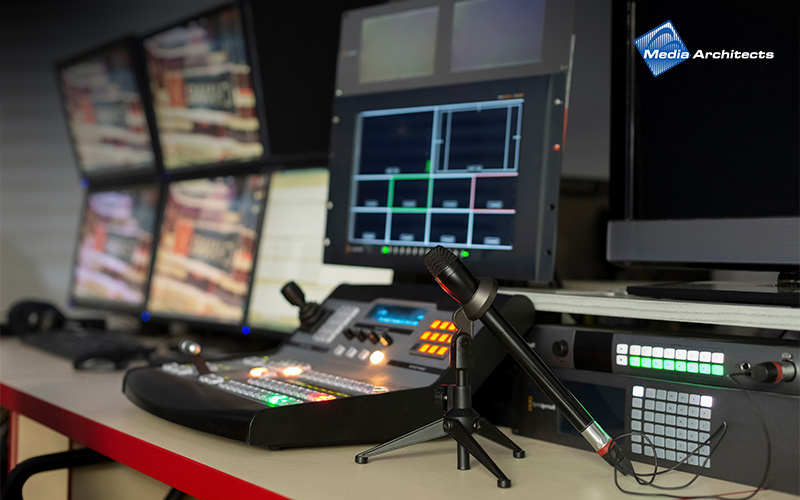
Many organisations are reassessing their media operations as digital channels expand and on-site manpower becomes more challenging to scale. A remote broadcast approach offers faster turnaround, improved cost control and reliable support for hybrid or multi-site events without sacrificing visual or audio quality.
It also aligns with wider industry movements toward network-based control, reduced cabling and more streamlined workflows. With thoughtful planning, integrated systems and support from knowledgeable audiovisual equipment suppliers, teams can build processes that remain resilient as demands evolve. The shift marks a future in which agility, connectivity, and consistency play a central role in decentralised media operations.
For organisations using LiveU, this agility is reinforced through portable transmission units that integrate seamlessly into remote workflows, allowing productions to scale rapidly without fixed infrastructure at every venue.
A well-designed remote broadcast model enables broadcasters, institutions, churches, studios, agencies and corporate media teams to deliver cohesive experiences across multiple venues. With dependable hardware and modern IP networks, this approach strengthens collaboration, eases logistical pressure and allows greater creative flexibility.
As Singapore moves further into hybrid events and distributed media environments, adopting centralised production workflows becomes a practical way to support future-ready broadcasting.
If you are exploring options to refine your workflows and guide your decentralised teams more effectively, contact Media Architects for support tailored to your production goals.
Related Pages
Other articles

January 7, 2026
Key Takeaways: Enterprise training is moving beyond one-off workshops towards continuous learning systems that support long-term skill development and workforce adaptability. Digital platforms powered by modern educational technologies create scalable...

December 19, 2025
Key Takeaways: AVoIP gives organisations a more flexible and scalable way to distribute audio and video using their existing network infrastructure. Software-based routing makes it easier to reconfigure rooms, support...

.svg)