

.svg)
Building Connected AV Ecosystems for Smarter Collaboration
May 11, 2026
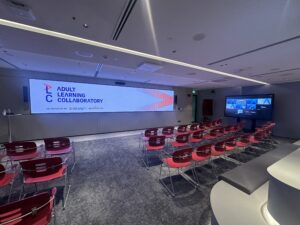
If you manage multiple rooms or buildings, you have likely noticed how quickly AV systems begin to diverge. A lecture theatre runs on one setup, meeting rooms operate differently, and larger venues often end up with their own standalone configurations. Over time, each space begins to function as its own independent system.
What starts as small differences in setup can gradually lead to inconsistent user experiences, more complicated troubleshooting, and increased effort to maintain systems across your spaces.
Effective AV integration is not simply about adding better equipment into each room; it is about defining how every space fits within a single, connected system from the outset. When a platform like Q-SYS is placed at the core, audio processing, video routing, and control no longer operate in isolation. Instead, they are designed within the same software-based environment and delivered over a shared network.
While each space has unique requirements, a unified architecture is the backbone that manages and controls them all consistently.
In practical terms, this provides a more structured way of working. Instead of managing separate signal chains and control logic across rooms, you operate within a unified architecture that can be applied consistently and adjusted where needed.
Different spaces require different configurations. A lecture theatre demands wide, even audio coverage, while a seminar room needs flexible control. An auditorium, on the other hand, must handle multiple inputs, switching, and streaming.
The challenge lies in how these configurations are implemented. In many setups, each room is built separately, with audio DSP, control systems, and video switching deployed as independent layers. While functional, these layers do not share the same processing environment or control logic. Consequently, simple changes, such as adjusting audio routing or switching sources, often require manual coordination across systems.
With well-designed AV solutions and, more importantly, robust AV integration, these functions are unified within a single platform. Audio processing, video distribution, and control commands operate within the same system, typically over a shared network. Signal paths are defined in software, enabling routing, processing, and control to function cohesively, rather than in isolation.
This directly affects how your rooms “behave”. Control interfaces can follow the same structure across spaces, and presets can trigger multiple system actions simultaneously. Signal routing remains consistent, even when room configurations differ.
Working with experienced audiovisual companies ensures this is built into the design. Each room may use different microphones, speakers, or displays, but they operate on the same underlying logic.
For you, that means fewer variables during operation. When something changes, you are adjusting a system you understand, not coordinating multiple independent ones.
Hybrid environments often highlight weaknesses in system design. Managing multiple microphones, camera feeds, and remote participants simultaneously can quickly lead to problems if these elements are not properly integrated. Audio becomes inconsistent, camera switching feels disjointed, and delays begin to affect the session.
Microphones feed into a DSP engine for echo cancellation, noise reduction, and gain control, while spatial processing maps each voice to a distinct location. Camera behaviour can be linked to system logic, and video is routed over the network without separate hardware chains.
With specially integrated beam-forming microphones, it is possible for the AV Control System to determine the originating position of a voice, and to activate a PTZ Camera to focus on that speaker. This provides remote participants a clear view of the person speaking.
All of this resides within a coordinated control layer. Through AV control platforms, a single command can trigger multiple actions across the system. Starting a session is no longer a sequence of manual steps, but a predefined workflow executed instantly.
As your setup expands across more rooms, consistency depends on how well each component is specified and integrated from the outset. This is where dependable audiovisual equipment suppliers support the system design, ensuring compatibility between devices and long-term stability.
The result is a system where the complexity is resolved in the design phase, not during the session itself.
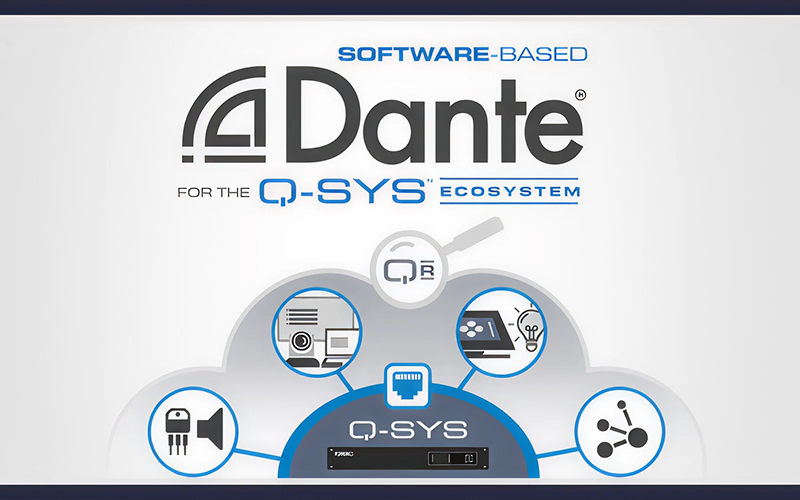
When overseeing multiple spaces, real time monitoring becomes as important as performance. Without it, issues tend to surface only when something goes wrong during a session.
In a networked enterprise AV system setup, your rooms are no longer isolated. Every processor, endpoint, and device exists within the same connected environment. With Q-SYS, these components communicate continuously over the network, providing a live view of system performance.
This extends beyond simply knowing whether a device is online. You can track signal flow, monitor audio levels, and pinpoint exactly where a fault occurs within the chain. If something requires attention, adjustments can be made remotely, such as fine-tuning levels or resetting a device, without needing to enter the room.
The shift is subtle but important. Instead of addressing issues room by room, you are managing a system that can be monitored and adjusted holistically.
Auditoriums and event spaces tend to show how a system has been put together. Over time, it is common for these spaces to end up with separate setups for audio, video switching, streaming, and control. Each part works on its own, but they do not always work smoothly together.
The limitations of this fragmented design become most apparent during live events. Transitions between segments, such as switching from a presentation to a live feed, often demand manual coordination across multiple systems, increasing the potential for delays or errors.
In a well-designed system with AV integration, all components are integrated, working together within a single architecture rather than as separate layers. Audio processing is centralised within one DSP environment, enabling the unified management of multiple microphone inputs and speaker zones. Video sources can be routed over the network, rather than relying solely on fixed switchers, providing greater flexibility when handling diverse event formats. Control logic ties both together, allowing transitions to be executed through a single interface instead of across multiple systems.
In practice, this creates a one-off system that adapts without the need for reconfiguration. Whether running a recurring event or a more complex production, configurations can be adjusted within the same framework.
For you, this translates to less time spent managing technical changes and greater confidence that the space will perform consistently when it matters.
Expansion is often where systems begin to lose structure. New rooms are added with disparate set-ups, and, over time, the overall environment becomes harder to manage and support.
However, with IT standards-based system architecture, such as Q-SYS, scalability is built into the system from the start. Rather than introducing separate set-ups, new spaces are added as extensions of the existing architecture, keeping everything aligned.
In a Q-SYS-based AV System, new rooms are integrated as network endpoints within the same system. Processing capacity can be increased through additional cores or licences, while integrations with conferencing platforms or other tools are handled through software, not hardware replacement.
The result is continuity. The system does not need to be rebuilt as your requirements grow. Instead, it evolves in a controlled way, with new spaces following the same logic as the rest of your environment.
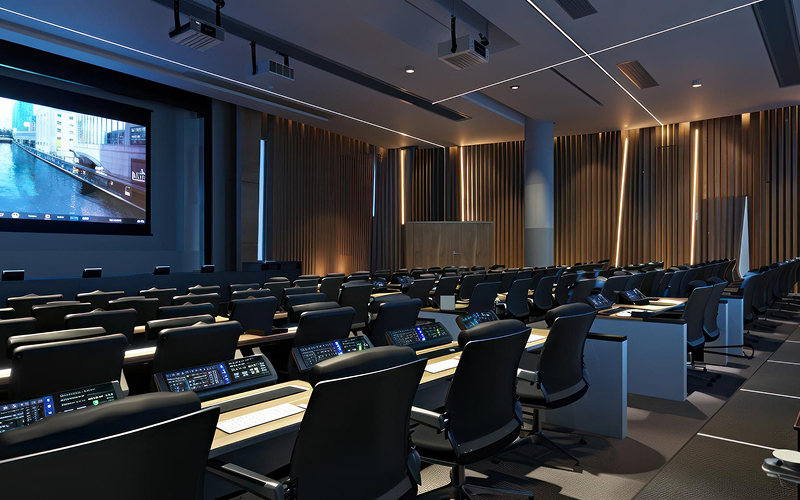
When a system is built on a unified architecture, the difference becomes clear in daily use. Instead of switching between disparate control logics or working around mismatched systems, signal flow, control, and monitoring follow a consistent structure across every space. This makes issues easier to trace and changes easier to manage. Whether overseeing a meeting room or a large venue, the system behaves predictably.
This is where AV integration delivers real value, moving you away from managing individual rooms and towards managing a connected environment that continues to perform well as your needs grow.
If you are planning to upgrade or redesign your AV infrastructure, Media Architects works with organisations to develop systems that are structured, scalable, and built for long-term use.
Speak with the team to explore how your spaces can be designed to operate consistently across your entire environment.
Related Pages
Other articles

November 6, 2024
Learning has evolved with time and classrooms have moved beyond traditional teaching methods. These days, almost every school is integrating edtech solutions to improve learning and make the entire education...

.svg)