

.svg)
Active Learning AV Solutions: 11 Products That Are Redefining Collaboration and Engagement in Modern Classrooms
September 18, 2026

The classroom today feels different. It is no longer centred on a single voice at the front, with rows of students quietly listening. There is movement, conversation, and a steady exchange of ideas. Discussions happen across tables, content appears across multiple screens, and participation extends well beyond the physical room.
At the heart of this shift are active learning AV solutions. These systems bring together audio, video, and control in a way that supports real-time interaction. Technology is no longer something that sits on the side. It shapes how lessons unfold, how students contribute, and how ideas are explored together.
When everything is thoughtfully put in place, the difference is noticeable. The classroom feels more responsive. Conversations carry more energy. Visuals help ideas land more clearly. Even remote participants feel part of the same flow. Learning starts to feel shared, not one-directional, and that changes the entire experience.
Every engaging classroom has something holding it together behind the scenes. It is not always visible, yet it shapes how smoothly everything runs. Layout, connectivity, and control come together as one system, supporting interaction instead of getting in the way.
Active learning AV solutions start with this kind of planning. The space, the way people move and interact, and the technology itself are considered as a whole rather than separate pieces. When these elements align, the environment feels natural. Instructors can shift between activities without breaking the flow, while students stay focused on contributing rather than figuring out how to use the tools in front of them.
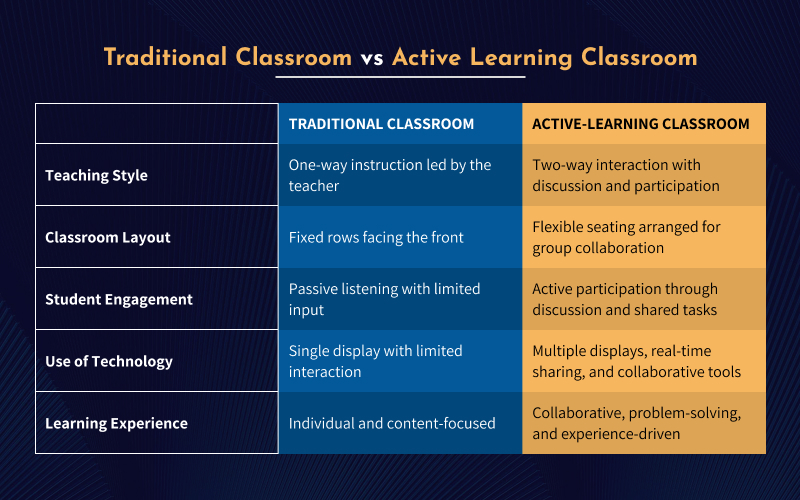
An active learning environment moves away from fixed rows and one-way instruction. It encourages movement, conversation, and collaborative problem-solving, positioning students as active participants rather than passive observers.
Typically, students are grouped together rather than facing forward. Each cluster can connect to shared displays, present ideas, and respond to others in real time. Technology operates in the background, supporting these interactions unobtrusively.
Clarity is also crucial. When visuals are sharp, and audio is evenly distributed, everyone remains engaged. Whether someone is in the room or participating remotely, they can follow the discussion seamlessly, without missing crucial points. This fosters a sense of equality, ensuring every voice is heard.
Audiovisual integration has a direct impact on the delivery of a lesson. It is not simply about connecting devices, but about ensuring that a session feels smooth and continuous, rather than interrupted and difficult to follow.
Many classrooms feature systems that have been added piecemeal over time, rather than designed holistically. A display, a microphone, and a conferencing platform may each work independently, but when used together, gaps begin to emerge. Switching between inputs takes longer than expected, audio levels fluctuate, and delays disrupt the discussion.
These small issues add up. They break the flow of teaching and make it harder for students to stay engaged, especially in settings where participation and collaboration are expected. Research on active learning classrooms and student engagement shows that classroom design and technological integration can influence how actively students engage and how effectively they learn, particularly in environments built for collaboration.
A well-integrated setup transforms this dynamism. Audio, video, and control systems respond in unison, allowing educators to transition between activities without having to stop and adjust equipment. Content can be shared instantly, student contributions can be incorporated into the discussion, and transitions occur seamlessly.
Over time, this consistency improves learning online. Lessons feel more fluid, and participation becomes more natural. This is where active learning AV solutions make a tangible difference: by reducing background friction, they allow both teaching and learning to remain focused on the interaction itself.
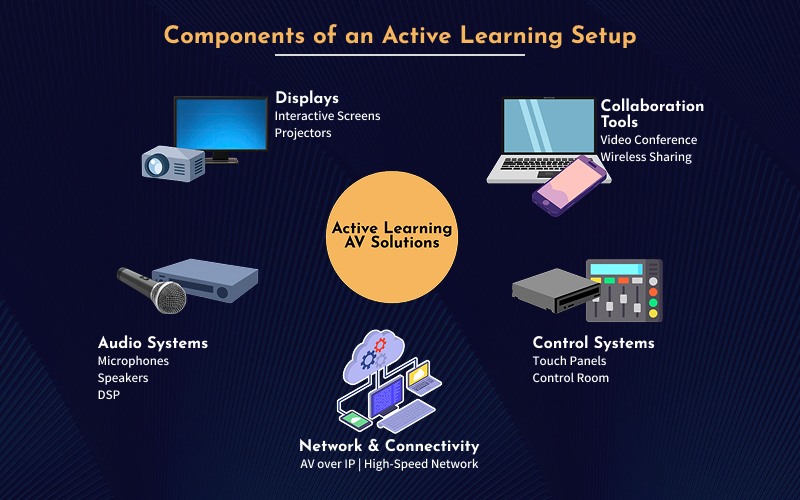
An active learning environment is not built around a single piece of equipment; it comprises several interconnected layers that work together to support interaction and collaboration.
At the centre is the display layer, which typically includes interactive panels or projection systems. These allow content to be presented, annotated, and shared across the room, serving as both teaching tools and collaboration surfaces.
The audio layer ensures clear communication. Microphones, speakers, and digital signal processing (DSP) systems manage voice capture, echo cancellation, and sound balance, ensuring every participant can hear and be heard without strain.
Control systems form another key layer, allowing instructors to manage sources, adjust audio levels, and switch between teaching modes through a single interface. This reduces the need to operate multiple systems separately and helps maintain lesson flow.
Collaboration tools, such as wireless presentation systems and classroom software, enable students to share content directly from their own devices. This supports group work and allows ideas to be exchanged more fluidly during sessions.
Finally, the network layer connects everything. Many modern systems rely on AV-over-IP infrastructure, which allows audio and video signals to be transmitted over standard networks. This makes the system more flexible, easier to scale, and simpler to manage across multiple rooms.
When these layers are properly integrated, active learning AV solutions become easier to operate and more effective in supporting interactive teaching.
Implementing an AV system involves more than simply selecting the right equipment. Several practical factors influence how effectively the system performs in daily use.
Room layout and size are among the primary considerations. The placement of displays, microphones, and speakers must align with the space’s intended use. A setup designed for lecture-style delivery may not function effectively in a collaborative, group-based environment.
Acoustics also play a vital role. Hard surfaces, high ceilings, and background noise can affect the clarity of speech capture and distribution. Appropriate microphone selection and DSP configuration can help address these challenges.
Network infrastructure is another critical factor, especially for systems that rely on AV-over-IP. Sufficient bandwidth, stable connectivity, and appropriate network design are necessary to support smooth audio and video transmission without latency or dropouts.
Ease of use should not be overlooked. Overly complex systems can discourage adoption, even if they are technically advanced. Clear interfaces and simple workflows enable educators to operate the system confidently from the outset.
Scalability is equally important. Institutions often begin with a single room but may expand over time. Designing a system that can grow without requiring a complete rebuild helps manage long-term costs and avoids unnecessary disruption.
By considering these factors early on, institutions can implement active learning AV solutions that are not only functional but also practical, reliable, and aligned with teaching practices.
Creating these environments involves more than simply installing equipment; it requires a clear connection between teaching methodologies and the technology that supports them.
An experienced provider such as Media Architects brings this alignment into focus. From initial consultation through to implementation, each system is tailored to the institution’s teaching approach, room layout, and long-term objectives.
This involves more than selecting devices. It means ensuring systems operate together reliably, designing intuitive workflows, and developing user-friendly control interfaces that are simple to use from the outset.
For institutions seeking an AV system integrator in Singapore, the true difference becomes apparent in daily use. When everything functions seamlessly, the technology fades into the background, and the learning experience takes centre stage.
It is not one standout device that enlivens these environments, but the seamless integration of multiple technologies working in unison. Audio systems, control platforms, collaboration tools, and displays each play a crucial role in shaping the overall experience.
When these elements are properly integrated, they form a responsive setup that supports real-time interaction, clear communication, and flexible teaching approaches. Lessons flow more smoothly, transitions feel natural, and there is less need for pauses and adjustments.
This is where well-designed audiovisual solutions make a difference. When everything is aligned, the technology recedes into the background, allowing the focus to return to what matters most: the learning itself.
At the heart of many setups lies Q-SYS, discreetly coordinating the interplay of all components.
Rather than managing audio, video, and control as distinct layers, Q-SYS unifies them within a single, network-based platform. Microphones, cameras, and displays remain synchronised, guided by a central processing engine that maintains system-wide alignment.
This is where classroom AV control systems demonstrate their true value. Instructors can manage the entire space via a single, intuitive interface, switching between sources, adjusting audio levels, and controlling visuals seamlessly. There is no need to juggle multiple systems or second-guess background processes.
The result is a seamless experience. Transitions are smooth and natural, audio remains consistent, and visuals appear precisely where expected. Within active learning AV solutions, this level of control is crucial for maintaining momentum, ensuring that attention remains focused on the lesson rather than the technology itself.
Hybrid learning has become integral to contemporary education. No longer a mere contingency plan, it is now an expected and essential component for both students and educators.
ClassIn facilitates this by establishing a unified space where remote and in-person participants share a single learning environment. This eliminates a fragmented experience, ensuring everyone follows the same lesson, contributes to discussions, and collaborates within the same digital workspace.
Interactive whiteboards, breakout rooms, and live content sharing mirror the dynamics of a physical classroom, but with the added benefit of unrestricted participation regardless of location. Remote learners are actively engaged, rather than passively observing.
When properly integrated, ClassIn software seamlessly extends hybrid classroom capabilities within active learning AV solutions. It maintains continuity, enabling uninterrupted teaching and collaboration, irrespective of participant location.
Collaboration often depends on how easily ideas can be shared in the moment.
The Bluestream Wireless Multiview Presenter range supports this by allowing students and instructors to present directly from their own devices without relying on cables or lengthy set-up processes. Multiple users can share content simultaneously, making it easier to compare ideas, review group work, or transition between presenters without interrupting the session.
This immediacy changes the pace of interaction within the classroom. Discussions move more fluidly, students can contribute more spontaneously, and collaboration feels less restricted by the technology itself.
Beyond convenience, wireless presentation systems also support more flexible classroom layouts. Participants are not tied to fixed connection points, which allows spaces to be arranged around discussion and group work rather than around cabling infrastructure.
Within active learning AV solutions, these tools help create a more responsive learning environment where content sharing becomes part of the natural flow of discussion, rather than a separate technical step.
Interactive displays in education have evolved from simple presentation screens to become much more sophisticated tools.
Brands such as ViewSonic have transformed static surfaces into responsive spaces where students and educators can write, annotate, and develop ideas collaboratively in real time. Content is no longer simply displayed; instead, it is manipulated, refined, and shared as the session progresses.
This type of interaction offers a tactile quality. Concepts are easier to understand, feedback is immediate, and participation feels more intuitive. Within active learning AV solutions, these displays facilitate a shift from passive observation to active involvement, where engagement occurs spontaneously.
In a dynamic classroom, poor audio quality can quickly disrupt discussions. Inconsistent volume, missed contributions, or background noise can interrupt the flow of collaborative learning.
Audio-Technica microphones are designed to provide consistent voice pick-up across the room. Options such as ceiling-mounted arrays, boundary microphones, and wireless systems allow coverage to be adapted to suit different layouts, from small group clusters to larger teaching spaces.
These microphones work with DSP systems to manage echo cancellation, noise reduction, and gain control in real-time. This ensures that speech remains clear and intelligible, even in hybrid environments where audio is shared across platforms.
Clear and balanced audio reduces the need for repetition, supports natural discussion, and ensures that all contributions are captured. In practice, this helps maintain lesson flow and promotes consistent participation across the room.
In active learning environments, clear communication is paramount. Sennheiser facilitates this with wireless microphone systems and sound reinforcement solutions engineered for even audio coverage across the room.
Instructors benefit from the freedom to move without signal drop-offs, while students can speak at a natural volume and still be heard distinctly. This is particularly advantageous in larger classrooms or spaces with challenging acoustics, where uneven audio can impede participation.
Furthermore, Sennheiser addresses accessibility with assistive listening solutions, enabling participants with diverse hearing needs to remain engaged. When integrated with platforms such as Q-SYS or Crestron, audio remains synchronised with video and control systems, ensuring a consistent experience across both in-person and hybrid sessions.
Consistent audio coverage minimises misunderstandings, reduces the need for repetition, and promotes more natural interaction throughout the session.
Behind the scenes, platforms from Crestron, Extron, Kramer, Biamp, and AMX act as the control and processing layer that integrates all classroom components.
These systems go beyond basic switching, managing signal flow across the room and network. Video sources can be routed to single or multiple displays, whether it is the lecturer’s content, a student’s screen, or a remote participant feed. Audio is processed and balanced through digital signal processing (DSP) engines, which handle echo cancellation, noise reduction, and automatic level control to maintain clarity across different speaking positions.
Control interfaces, typically touch panels or tablets, are customised to simplify operation. With a single action, instructors can start a session, switch between teaching modes, or share student work. Some systems also automate routines such as powering on equipment, adjusting volume levels, or recalling preset configurations for different lesson types.
These platforms also support integration with other technologies. Lighting, cameras, and conferencing platforms can be linked into the same control system, creating a coordinated environment rather than independent systems.
Within active learning AV solutions, this level of integration ensures consistency. It reduces set-up time, limits user error, and allows lessons to run without interruption. The complexity remains in the background, ensuring a straightforward experience for both instructors and students.
The value of these systems becomes clearer when they are applied in real learning environments.
In collaborative classrooms, students work in small groups, sharing content wirelessly to central or group displays. This allows ideas to be compared, discussed, and refined in real time, rather than presented sequentially, one group at a time.
Lecture theatres rely on centralised control and distributed audio to maintain consistency. Content can be routed to multiple screens, while microphones and DSP ensure speech remains clear throughout the room and for remote participants. This supports large-scale teaching without compromising clarity or engagement.
Hybrid laboratories extend this functionality further. Live experiments can be captured, displayed, and annotated as they happen, enabling both on-site and remote learners to follow the same process. Multiple camera feeds and shared displays facilitate the demonstration of detailed work.
Breakout zones provide smaller, flexible spaces equipped with simplified control and display systems. These areas support focused group discussions, project work, or self-directed learning without the need for full-scale classroom setups.
Across these environments, active learning AV solutions and broader educational technologies support practical interaction. The systems enable sharing, visibility, and communication, while remaining unobtrusive during sessions.
When systems are properly integrated, the benefits are evident in everyday use, rather than existing as abstract improvements. Audio, video, and control components work cohesively, eliminating the need for constant manual switching. This minimises delays and ensures lessons progress smoothly.
A well-designed setup also facilitates scalability. A system that begins in a single classroom can be expanded to multiple rooms, or even across an entire campus, without requiring a complete system rebuild. Simultaneously, the infrastructure is designed to accommodate new tools and platforms, preventing institutions from being locked into a fixed setup as teaching methods evolve.
Ease of use is another tangible advantage. Simplified control interfaces and automated functions enable educators to manage sessions confidently, with less reliance on technical support. This reduces disruptions and allows them to focus more on teaching.
Energy management is also more efficient. Centralised control enables systems to be powered on and off as required, helping to reduce unnecessary energy consumption.
Collectively, these enhancements make active learning AV solutions more stable, adaptable, and sustainable over time, particularly in environments where consistency and reliability are paramount.
Active learning AV solutions are designed to shift learning from passive listening to active participation. They enable instructors and students to share content instantly, collaborate in groups, and interact across physical and virtual spaces. By integrating audio, video, and control systems, these solutions support real-time discussion, clearer communication and more engaging lesson delivery. In practice, these AV solutions help create a more balanced environment where every participant can contribute meaningfully.
Yes. Many AV systems are modular, meaning they can be introduced into existing classrooms without major structural changes. Components such as wireless presentation systems, interactive displays and upgraded audio can be added progressively. This allows institutions to improve functionality over time while managing costs and minimising disruption to daily operations.
Yes. Active learning AV solutions are well-suited to hybrid environments, where some participants are in the room, and others join remotely. Platforms such as ClassIn and Q-SYS help ensure that both groups can see, hear and interact with each other in real time. Features like shared content, live annotation, and consistent audio distribution help maintain a unified experience across locations.
Most modern AV systems are designed to work across brands using standard communication protocols. This allows institutions to combine solutions from different manufacturers, such as control systems, microphones, and displays, into a single setup. This flexibility makes it possible to build configurations that match specific teaching needs, rather than being limited to a single vendor.
Following deployment, institutions typically receive onboarding support, which includes user training, system walkthroughs, and documentation. Ongoing support may encompass remote monitoring, troubleshooting, and maintenance services to ensure continued reliable system performance. This support is particularly important when implementing active learning AV solutions, as it helps educators adapt to the technology confidently and ensures the system remains effective as requirements evolve.

The landscape of learning is changing. Technology is no longer a mere adjunct to teaching but fundamentally shapes lesson delivery, sharing, and experience.
Active learning AV solutions foster a more connected flow between people, content, and environments. The distinction between physical and digital spaces diminishes, creating a more natural and consistent participatory experience across diverse settings.
However, the outcome hinges on system design. Poor integration can render even advanced setups disjointed and difficult to manage. The key is ensuring each component works in harmony to provide practical and reliable support for teaching.
This is where an experienced partner becomes invaluable. Media Architects designs and implements integrated classroom environments tailored to real teaching needs and everyday use.
To enhance your learning spaces or create a more connected classroom environment, speak with the Media Architects team to explore a solution tailored to your institution.
Related Pages
Other articles

September 18, 2026
Key Takeaways: The digital classroom supports a more flexible learning experience, where lessons can be delivered, revisited, and built upon beyond a single session. Media-rich content helps make complex ideas...

September 17, 2026
Key Takeaways: Active learning with AI allows classrooms to respond in real time, enabling educators to tailor their teaching based on actual student engagement rather than assumptions. Intelligent systems reduce...

September 8, 2026
Key Takeaways: Multi-camera production enhances visual storytelling of an event from various viewpoints for a more dynamic and immersive experience for the audience. A well-integrated setup ensures consistent experiences across...

.svg)