

.svg)
Hybrid Virtual Classroom: How Educational Technologies Are Shaping the Future of Learning
May 8, 2026
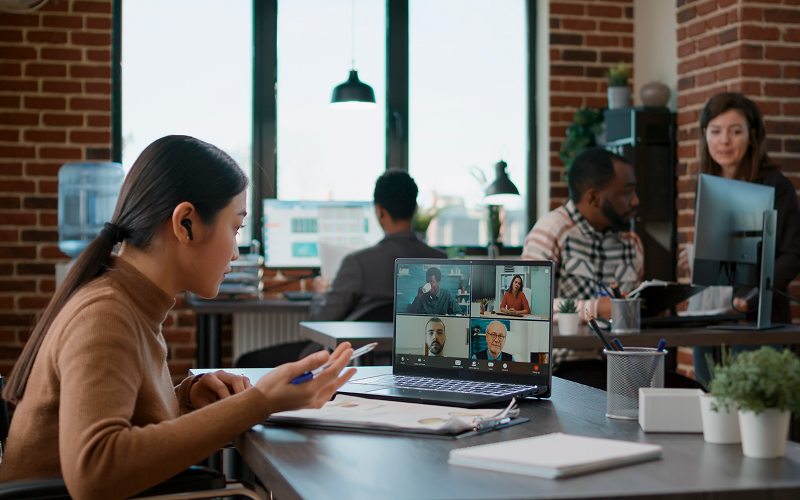
Education is no longer confined to the classroom. What was once dictated by a fixed timetable and location now extends across devices, platforms, and time zones, often simultaneously. This shift has naturally led to the emergence of the hybrid virtual classroom, where in-person and remote learners share the same experience, rather than being separated.
Within this setup, there is a subtle but significant change in the learning dynamic. A student joining from home can respond, ask questions, and collaborate alongside someone in the room without feeling like an afterthought. A trainer can address teams across different regions while maintaining a focused and engaging session. The experience feels less restrictive, more fluid, and better reflects how people learn and work today.
This is not about replacing traditional teaching, but about enhancing it. When supported by the right combination of audiovisual solutions, platforms, and thoughtful delivery, learning becomes more connected, adaptable, and sustainable over time.
Education today feels far less fixed than it once did. A growing mix of digital tools is quietly reshaping how learning happens, stretching it beyond the classroom and into everyday life. From hybrid classrooms to cloud-based platforms, teaching is no longer tied to a single space or format.
Learners can dip into materials when it suits them, join discussions from different locations, and interact with content in ways that feel more natural and engaging. It is no longer just about receiving information. There is more participation, more flexibility, and more room to learn at an individual pace.
As new media in education continue to evolve, institutions are rethinking how lessons are delivered, organised, and experienced. The result is a learning environment that feels more connected, more adaptable, and better aligned with how people learn today.
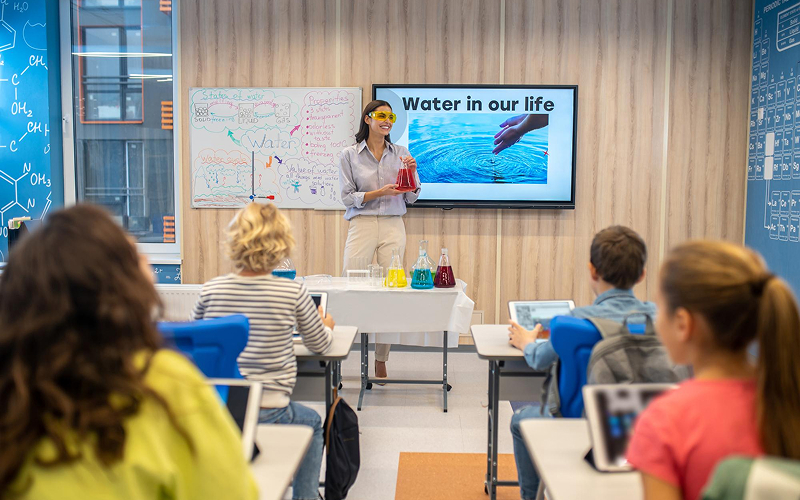
Educational technology has evolved significantly beyond basic online tools. It now integrates platforms, systems, and content into a connected ecosystem that supports teaching, learning, and routine administration.
At the heart of this evolution is the modern smart classroom, where physical and digital elements work in tandem. Lessons can be streamed, recorded, and reviewed, while learning resources reside in the cloud, ready to be updated or accessed at any time. Students are no longer confined to the classroom session; they can continue to engage with, contribute to, and revisit content afterwards.
This is where the hybrid virtual classroom takes shape, enabled by technology that brings in-person and remote learners into the same shared environment. Through integrated audio, video, and platform systems, both groups can participate within a single, continuous flow, rather than experiencing separate or disconnected activities.
Data adds a further dimension. Teachers can monitor how students interact with lessons, identify areas of difficulty, and provide targeted support. Learning becomes more responsive, adapting to individual needs rather than adhering to a rigid structure.
This feels less like a replacement of traditional teaching and more like an expansion, opening up new avenues for teaching, learning, and staying connected.
A range of technologies is shaping how learning feels today, not just how it is delivered. Each one plays a role in making lessons more connected, responsive, and engaging, especially in a hybrid virtual classroom where different formats come together in a single shared experience.
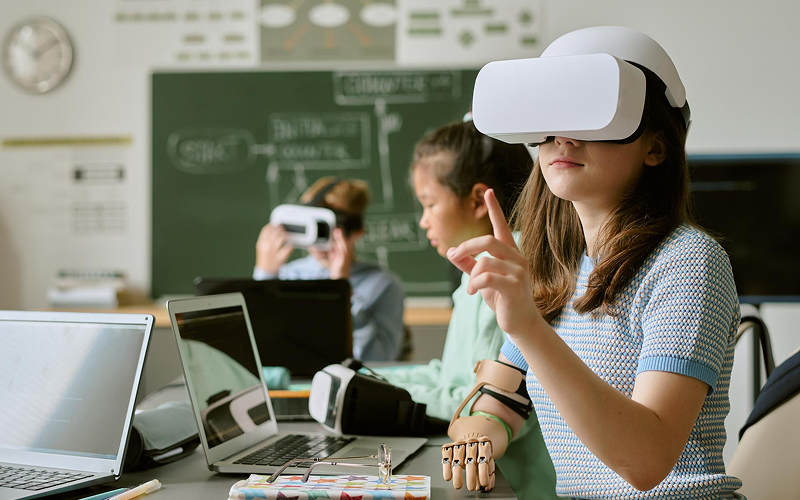
Virtual and augmented reality are pioneering new avenues for exploring ideas. Instead of merely reading about a concept, learners can now experience it directly. These immersive learning environments simplify complex topics by rendering them visually and interactively, thereby enriching any hybrid virtual classroom setup.
LMS platforms provide structure to digital learning. By housing lessons, assignments, and communication within a single system, they streamline management and navigation. Simultaneously, they afford learners the flexibility to progress at their own pace, a feature that integrates seamlessly into a hybrid virtual classroom where participation levels may vary across locations.
AI introduces an almost intuitive layer of adaptability. Content can be tailored based on a learner’s performance, providing support where needed and facilitating advancement where possible. Teachers also benefit from clearer insights into areas requiring attention.
Simple game mechanics, such as points, levels, and rewards, can transform learner engagement. By instilling a sense of progression and involvement, they convert lessons into participatory experiences rather than passive ones.
Accessibility is now integral to the learning process. Tools like screen readers and speech-to-text systems ensure broader participation, accommodating diverse learner needs.
Collectively, these innovations underpin the modern hybrid virtual classroom, where engagement, flexibility, and inclusivity are inherent to the experience from the outset, rather than being supplementary additions.
Educational technology is constantly evolving, shaped by the ways people learn, work, and interact. Several emerging trends are defining modern learning environments.
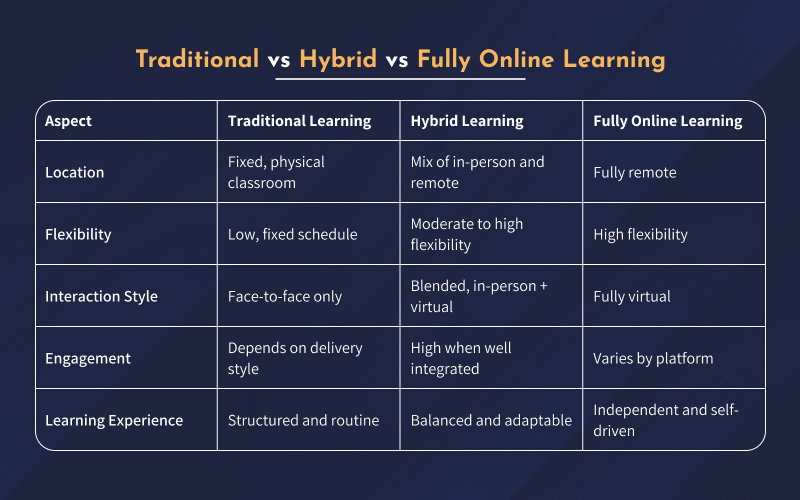
The hybrid virtual classroom has rapidly transitioned from a temporary fix to a standard approach. This means learning is no longer confined to a single location. In-person and remote participants can now join the same session, contributing in real time and feeling connected.
Data is being used more purposefully. Instead of relying on guesswork, educators can track engagement, performance, and progress. This allows them to refine teaching methods based on actual behaviour, making learning more responsive.
Learning is becoming easier to integrate into daily routines. Short, focused lessons delivered through mobile devices support those with limited time. This feels less rigid, allowing people to learn when it suits them, rather than adhering to a fixed schedule.
Tools such as 3D design and digital prototyping are bringing a more practical element into learning. Ideas can be tested, refined, and brought to life, helping learners move more naturally from theory to application.
Digital platforms reduce the need for printed materials and physical resources. This quieter shift contributes to broader sustainability efforts while supporting the scalability of the hybrid virtual classroom.
Together, these trends are shaping learning into something more flexible, accessible, and aligned with how people engage with information today.
The sharing and application of knowledge is undergoing a noticeable transformation. The rise of digital learning solutions is making lessons more engaging, often incorporating multimedia, real-time interaction, and carefully considered pacing. Simultaneously, data is providing a clearer picture of learner progress, enabling educators to respond with greater accuracy.
These changes extend beyond educational institutions. Organisations are adopting similar strategies to develop training programmes that can be scaled across teams and locations, promoting consistent yet adaptable learning experiences.
The hybrid virtual classroom is central to this shift, introducing flexibility while maintaining connectivity for both in-person and remote participants.
Overall, learning is becoming more accessible, measurable, and aligned with real-world demands. It is evolving from a one-way transmission into an ongoing exchange, facilitated by tools that encourage participation and continuous improvement.
Teaching feels noticeably different today, with the educator’s role evolving from content delivery to learning facilitator.
Interactive teaching tools enhance lessons, making them more dynamic and engaging. Real-time discussions are now possible, irrespective of participants’ locations, while visual content, simulations and shared workspaces encourage active participation rather than passive absorption.
Blended learning has also become commonplace. Students might review materials before a session, using class time for questions, application and deeper exploration of ideas. This creates a more balanced flow, making classroom time feel purposeful, not rushed.
The hybrid virtual classroom further strengthens this experience by providing a shared space for both in-person and remote learners, enabling seamless interaction across different formats.
Collaboration has also transformed. Digital platforms enable students to work together regardless of location, fostering communication skills that reflect real-world environments.
The impact of educational technology extends far beyond the classroom, influencing how people access knowledge, how institutions operate, and how organisations develop capabilities. The result is a more flexible and responsive learning ecosystem, better aligned with real-world demands.
Learning is no longer restricted to a specific place or time. Students and professionals can access content from almost anywhere: at home, in the office, or while travelling. This creates opportunities for those previously excluded and makes it easier to revisit materials and learn at their own pace.
Lessons are more active and less passive. Multimedia content, live interaction, and hands-on activities draw learners into the experience. Instead of simply listening, they respond, discuss, and apply ideas, reinforcing their understanding.
Many time-consuming tasks can now be streamlined. Digital systems can handle grading, attendance tracking, and content distribution, reducing manual effort. This allows educators and administrators to focus on teaching quality and student support, rather than routine processes.
There is now greater visibility into the learning process. Institutions can track participation, identify patterns, and understand where learners need additional support. This leads to more informed decisions and continuous refinement of teaching strategies.
Learning environments are beginning to mirror real-world workplaces. Collaboration tools, digital platforms, and problem-solving activities reflect workplace scenarios, helping learners build practical skills alongside theoretical knowledge.
Education is no longer confined to a fixed period. Individuals can return to learning at different stages of their lives, acquiring new skills or deepening existing ones. Short courses, certifications, and on-demand content make it easier to continue learning without major disruption.
For organisations, digital learning solutions are particularly valuable. Training can be delivered consistently across teams and locations, while still allowing for adaptation. This supports a continuous approach to development, where learning evolves alongside business needs, rather than being treated as a one-off event.
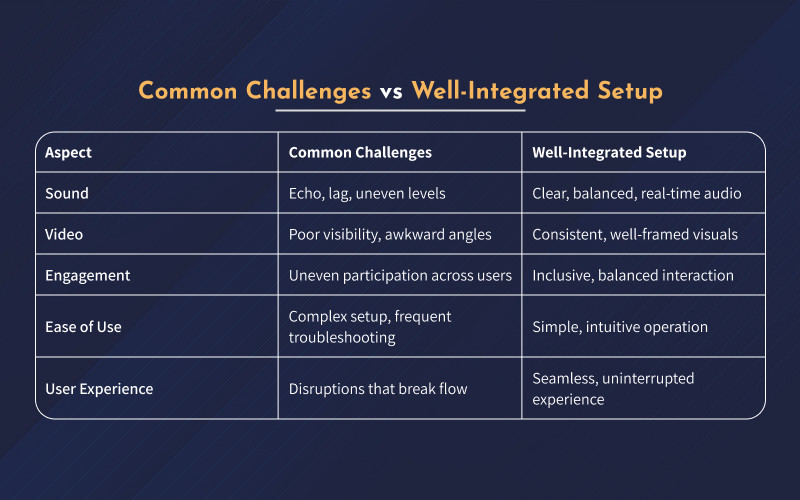
A well-functioning hybrid virtual classroom is rarely accidental; it’s the result of carefully integrating every element, from the technology itself to its practical application.
Audio clarity, video quality, and overall system reliability are all critical. When these elements are misaligned, the experience quickly becomes disjointed, with delays, uneven sound, and disengaged participants. However, when properly integrated, the experience feels smooth and natural, with technology supporting the session seamlessly.
This is where experienced audiovisual equipment suppliers become invaluable. Their focus extends beyond simply selecting the right hardware to ensuring that everything functions as a unified system. Microphones, cameras, and displays must operate within a cohesive setup, providing both in-person and remote participants with the same level of clarity and interaction.
Software platforms are equally important. Tools such as ClassIn help structure the learning experience, supporting features like real-time collaboration, breakout discussions, and content sharing without disrupting the session’s flow.
When these elements come together, the result is a learning environment that feels cohesive and well-paced. Even with participants joining from different locations, the experience remains connected, focused, and easy to engage with.
A hybrid virtual classroom combines in-person and remote learning in a single session. Both groups participate simultaneously, using integrated technology to communicate, interact, and collaborate as part of a shared experience.
Not necessarily. When well-designed and managed, they can actually enhance engagement and flexibility. The challenge usually arises from an inadequate setup. If the audio is unclear or participation feels uneven across learners, the experience can quickly become fragmented.
They don’t have to be. Many organisations begin with a basic setup and expand it over time. As needs become clearer, additional tools and features can be introduced without overcomplicating the process.
It makes a significant difference. Without proper integration, even robust platforms struggle to deliver a consistent experience. Reliable audio-visual technologies help ensure that communication remains clear, stable, and easily accessible for everyone.
Yes, absolutely. Many organisations use them for training, onboarding, and professional development. The format is easily adaptable to corporate settings, particularly when teams are geographically dispersed.

Education is no longer confined to a single space or a fixed format. Instead, it moves across platforms, devices, and locations, shaped by the way people naturally learn and interact today.
The rise of the hybrid virtual classroom reflects this shift, bringing together flexibility, engagement, and accessibility in a way that aligns with modern routines. However, it also raises new considerations regarding system design, integration, and overall user experience.
There is no one-size-fits-all model. While some spaces benefit from more advanced setups, others work better with simpler, more focused configurations. The most important factor is how well the system supports clear communication and meaningful interaction.
For organisations entering this space, the focus should extend beyond simply adopting new tools. It’s about creating learning environments that feel intuitive, connected, and easy to engage with over time.
To explore how integrated systems and audiovisual technologies can support your learning environment, speak with Media Architects and discover the potential of a well-designed hybrid virtual classroom.
Related Pages
Other articles

July 12, 2024
Traditional teaching methods, which often rely on textbooks, lectures, and standardised tests, may struggle to captivate today's technology-savvy students. Exposed to digital media and advanced devices from a young...

Source: Panopto As Singapore’s education system embraces digitalisation, it has moved beyond traditional textbook-based learning and teacher-led instruction to adopt technologically advanced learning environments. This transformation is facilitated by...

.svg)